
Kentucky VINE in Knox County
VINE stands for Victim Information and Notification Everyday. The Kentucky Department of Corrections VINE page describes a statewide service that gathers custody data from jails, prisons, mental-health facilities, and other covered systems. The Kentucky Attorney General also notes round-the-clock access for covered local jails and adult correctional facilities.
Knox County has its own doorway into that network. The detention center's inmate-services page lists VINE among its offerings. Use the Kentucky person search for any Knox booking. Speed is not promised, though. Not every intake appears instantly. Fields can lag or sit blank. An urgent gap belongs with the Knox County Detention Center.
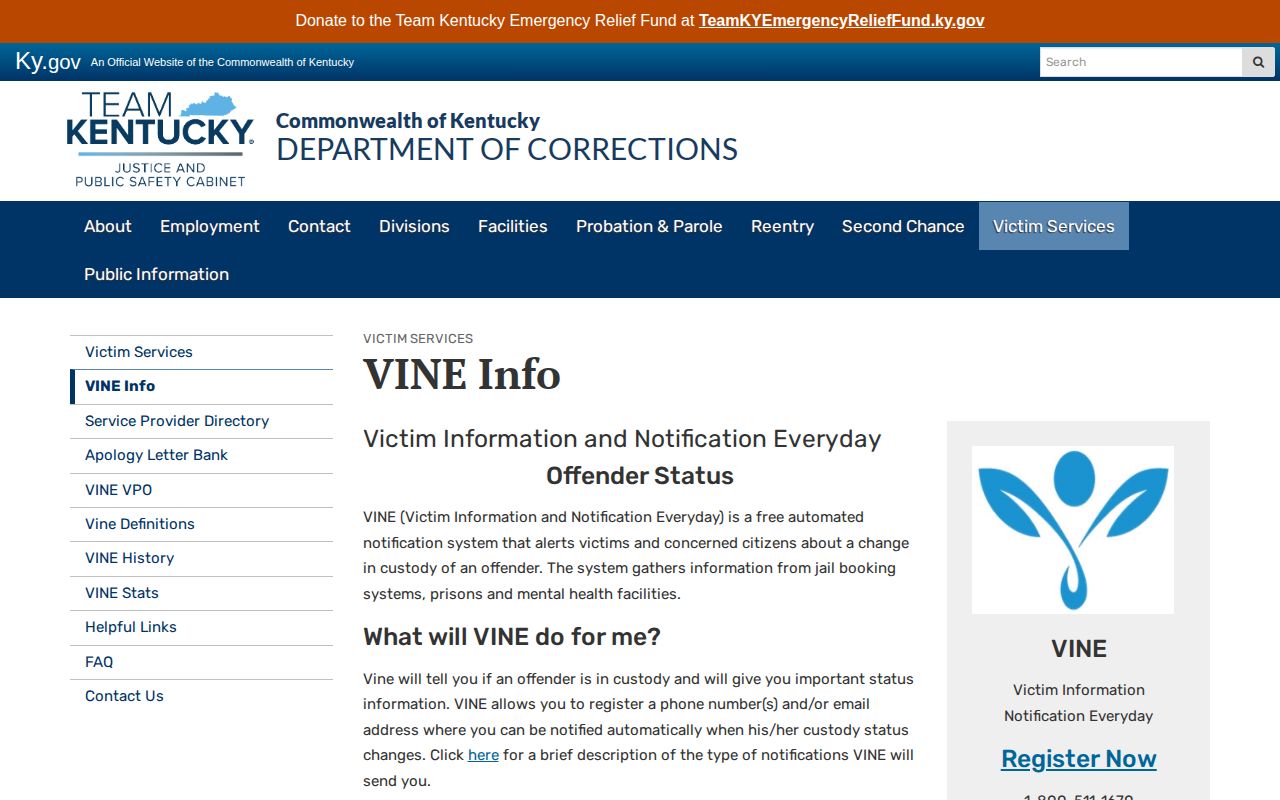
The official Kentucky VINE information page also spells out the state's notification policy and contact routes.
State guidance helps only so far. The live VINELink result is where one particular person gets checked. Do not confuse this service with the Knox booking feed. The jail feed tracks fresh intake. The roster shows who is currently recorded. VINE follows reportable custody status. A released booking can still have an open court case. A transfer to state custody creates a different institution record.
Check a Knox County Arrest
Start with the Kentucky-specific person search. A name alone is not enough, since common names and spelling differences can return several matches.
- Open the VINELink Kentucky person search.
- Enter the person's full name or identification number. Try reasonable spelling variants if the first search is empty.
- Open a possible result and compare its facility, status, and identifier with the facts you already know.
- Do not merge two people based only on a matching name. Use the facility or ID to narrow the match.
- If the arrest is very recent, check the Knox jail route and call the jail before concluding that the person is not held.
- Use CourtNet or the Knox clerk for charge changes and case disposition, which VINELink does not decide.
The Knox County recent-arrest guide handles booking and court records. VINELink covers custody status only. The Kentucky VINELink search screen holds the name and ID controls used before a result opens.

The Kentucky VINELink search screen shows only the entry fields, with no gallery and no booking photograph.
Knox County VINELink Result Fields
A VINE match is a custody record drawn from a participating source. Kentucky lists practical fields and events. The live result controls what appears for one person.
| Field or event | What it means |
|---|---|
| Name or person ID | Search and matching information; use the ID when similar names appear. |
| Custody status | The status currently reported to VINE, which may lag a new jail event. |
| Facility | The participating jail or institution reporting custody. |
| Facility contact | Address or phone information that may be shown for direct confirmation. |
| Release event | A custody change, not an acquittal or dismissal. |
| Transfer event | A move between facilities or systems, not the end of the court case. |
| Booking photograph | Not a reliable VINE function and not promised by Kentucky's custody-alert guidance. |
Note: VINE status and a Knox jail booking record serve different purposes and can update at different times.
Register for Kentucky Custody Alerts
Confirm the right person first. Kentucky offers voluntary, confidential registration through VINELink or the statewide phone line.
- Select the notification or registration option attached to the confirmed person record.
- Choose the offered contact method, which may include phone, email, text, app, or TTY.
- Enter one or more reachable phone numbers or email addresses as the service permits.
- Create and retain the four-digit PIN required for phone notification acknowledgement.
- Review the custody events covered by the registration, such as release or transfer.
- Keep direct jail and emergency contacts because an automated alert is only one part of a safety plan.
The statewide phone route is 1-800-511-1670, with TTY at 1-866-847-1298. Automated calls can arrive at any hour. Use a phone that accepts the call. It must also take PIN entry. Tie registration to the confirmed person, not the first similar name. Update your contact details. Do this whenever a number or email changes. Note the facility and VINE record identifier too. That way an unexpected alert can be traced to the right match without guessing.
VINELink Limits in Knox County
No Knox County feed interval is published. A fresh arrest can sit in intake. A release can happen before the status moves. Time-sensitive facts belong with the jailer at (606) 546-6215. The 24 Hour Arrests guide covers the recent-bookings and current-roster checks separately.
VINE is not a federal locator. Do not assume it covers the Federal Bureau of Prisons, ICE, or every Marshals Service detainee. A Knox booking that becomes Kentucky DOC custody may appear in both KOOL and VINE. Federal or immigration custody takes a federal channel.
VINELink decides no legal outcome. Release can follow bond, a served sentence, a transfer, or another custody event. The case record lives elsewhere. CourtNet and the Knox circuit or district clerk hold the public case path.
How Kentucky Release Calls Work
Kentucky uses a specific acknowledgement method for phone alerts. After a jail release, the system can leave a message. It may keep calling for roughly 24 hours. The calls stop only after you enter the four-digit PIN. That design is why the registered number and saved PIN matter so much.
A release call reports a custody event, nothing else. It cannot tell you whether a Knox County charge is pending, changed, or ended. Verify the event in the live system once alerted. If timing affects a safety plan, contact the facility directly. Kentucky DOC victim services lists (502) 564-5061 and toll-free (877) 687-6818. Its email is OVS.Help@ky.gov for program context.
Email, text, and app notices depend on your live-registration choices. Kentucky lists those channels, though exact options can shift by event or record. Follow the current interface. Keep any confirmation it provides. A blocked call or failed message is not proof that custody stayed the same. Check VINE again instead.
Knox Custody Stages and Alerts
A fresh booking lands the person in the Knox County Detention Center's roster first. After release, that name may drop off even while the booking file and court case live on. A transfer into Kentucky state custody shows up instead through KOOL and state VINE reporting. Each system answers a different question. That is why two official sources can disagree without either being wrong.
VINELink registration costs nothing, and its job is notification. It does not publish a booking photo or a full arrest record.
No Knox result does not mean no arrest. A citation and release can leave an agency trail and a court case without any county jail custody. Corbin complicates things too. The city sits across county lines, so a Corbin arrest may be booked in another county entirely. Ask the arresting agency which facility took the person in before you keep searching the wrong place.
Save the search time and the status word for word when you get a recent result. If a dispute comes later, call the facility itself. A screenshot proves nothing. VINE data shifts the moment a release or transfer gets reported, and yesterday's status is not a statement about where someone is held today. The same caution applies to alerts shared with family: state the time received, check the facility named, and add nothing the notice does not say.
Multiple matches call for a slower approach. Start over with an identification number if you have one. Without it, compare the facility and status against the confirmed arresting and booking agencies. Age, looks, or a partial name alone never settle who a record belongs to. A doubtful match stays doubtful until the facility confirms it.
The detention center's published VINE link beats any unofficial jail directory as evidence. It still cannot reveal the handoff schedule behind the scenes. Expect the live state search to show only what the participating system has reported. For someone just booked, direct jail contact is faster. Once a person has moved, the receiving institution is the better confirmer.
Write down the time and event, reopen the live record, and call the facility named there. Court questions belong to the Knox clerk. State prison placements go through Kentucky DOC and KOOL. Federal placements need the responsible federal locator. Each path keeps one service from answering a question outside its role.